
Black knot (Dibotryon morbosum) is a prevalent disease in the Canadian prairies. It occurs naturally and predominantly affects trees and shrubs within the cherry (Prunus) genus. Various species, including ornamental and edible cherries such as Mayday, Shubert chokecherry, chokecherry, Nanking cherry, pin cherry, sand cherry, and sour cherry, as well as Saskatoons and plums, are susceptible to this disease.
While black knot may significantly reduce crop yield in fruit production, it usually takes years, and sometimes even decades, to fully destroy a mature tree. Unlike rapid and lethal diseases that can kill a tree within a year or two, black knot progresses slowly. With proper management, the spread of the disease can be reduced and the eventual decline of affected trees and shrubs delayed or prevented.
Improper pruning and poor timing of pruning are major contributors to the spread of black knot. Avoiding pruning mistakes and selecting the appropriate time for pruning are critical to preventing disease transmission.
Identification of Disease and Symptoms
Recognizing black knot is relatively straightforward, particularly during fall and winter when infestations are most apparent. Dark, black-coloured swelling galls that resemble tumour-like growths on branches or stems can often be seen from a distance on affected trees.
In early summer, newly developed infections appear as velvety green or olive-coloured swellings along branches or twigs. The maturation of black knot, when the growth turns black, may take up to four years. During winter, spores mature, and a single average-sized black knot measuring 2 to 4 inches can release millions of tiny spores. These spores are dispersed in spring during wet periods and will spread naturally without intervention.
Mature black knots typically measure between 2 and 4 inches, although infestations as long as 10 inches on large branches are not uncommon. Deformed twigs and branches are frequent indicators of the disease. Galls encircle and constrict branches, ultimately causing the death of affected twigs and branches. Older black knots may be partially covered with a white or pinkish fungal mold or perforated by insect-made holes. Wood decay fungi may also infiltrate trunks or branches already weakened by black knot.
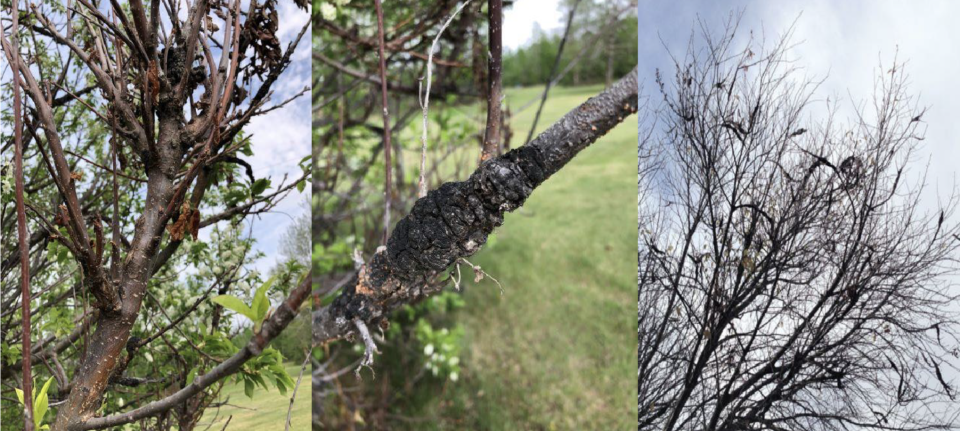
Pictures: Deformed branches (L), old black knot with pinkish/white mold (C) and heavy infested tree (R)
Management of Black Knot
Management of black knot focuses on limiting the natural spread of spores by wind and rain, although these factors cannot be fully controlled. One of the most common means of disease transmission is improper pruning during the growing season. The most effective management approach is regular monitoring of trees and shrubs, combined with timely and proper pruning practices to minimize risk. Selecting tree and shrub species resistant to black knot is also an effective strategy, as chemical control methods are not effective for this disease.
Effective timing for black knot control
- Pruning should only be conducted during winter when temperatures are well below 0°C. At this time, spores are inactive and unable to survive exposure to cold conditions. Trees and shrubs are also dormant, reducing the risk of damage from pruning cuts.
- Avoid pruning in late fall (September, October, and November) or early spring (March, April, and May). Late fall pruning can damage trees that have not fully entered dormancy, while early spring pruning may occur when spores are active and sap is already flowing.
- Refrain from pruning during the growing season unless a new infestation is observed for the first time. Pruning during this period is high risk and can contribute to disease spread.
- Avoid pruning on wet, rainy, or windy days, as spores are easily dispersed under these conditions.
Guidelines for proper pruning and removal
- Acquire basic knowledge of proper pruning techniques and follow appropriate safety precautions.
- Use suitable, sharp tools when pruning trees and shrubs.
- Be aware that the fungus spreads within the wood below visible infestations. Prune at least 12 inches, and preferably 24 inches, below the affected area.
- If pruning a limited number of infested branches during the growing season, disinfect pruning tools after each cut. In winter, disinfect tools both before and after pruning.
- Pruning back to the branch collar may be necessary for effective removal.
- In cases of severe infestation, complete removal of the tree or shrub is often the most effective option.
- Remove infested wood immediately. Proper disposal is as important as the pruning itself, as spores may continue to be released for up to four months after pruning. Do not leave infested branches near other trees or shrubs.
- For a small number of branches, place material in sealed garbage bags. Entire trees should be disposed of at a landfill. During winter, burning infested wood is also an acceptable option.
Additional Resources
Written by:
Toso Bozic, ISA Certified Arborist
ATTS Group Inc.